Dataverse Virtual Tables: Connections, Trade-offs, and Technical Best Practices
A technical guide to Dataverse Virtual Tables with official connection options, architecture trade-offs, ports, and practical production recommendations.

Dataverse Virtual Tables are one of the most useful integration patterns in Power Platform when your source of truth lives outside Dataverse.
This guide focuses on architecture, technical trade-offs, connector options, ports, and practical recommendations for production-ready implementations.
What Virtual Tables are
A virtual table is a Dataverse table definition that surfaces external data at runtime. Users see rows in model-driven apps and other Dataverse clients, but the data remains in the external system.
Supported connection approaches (official docs)
Microsoft documents multiple paths depending on your scenario:
- Virtual table fundamentals: Create and edit virtual tables with Microsoft Dataverse
- Virtual connector provider (connector-based): Create virtual tables using virtual connectors
- SharePoint connector reference: SharePoint connector
- SQL Server connector reference: SQL Server connector
- PostgreSQL connector reference: PostgreSQL connector
- Fabric + Dataverse integration context: Link Dataverse environment to Microsoft Fabric
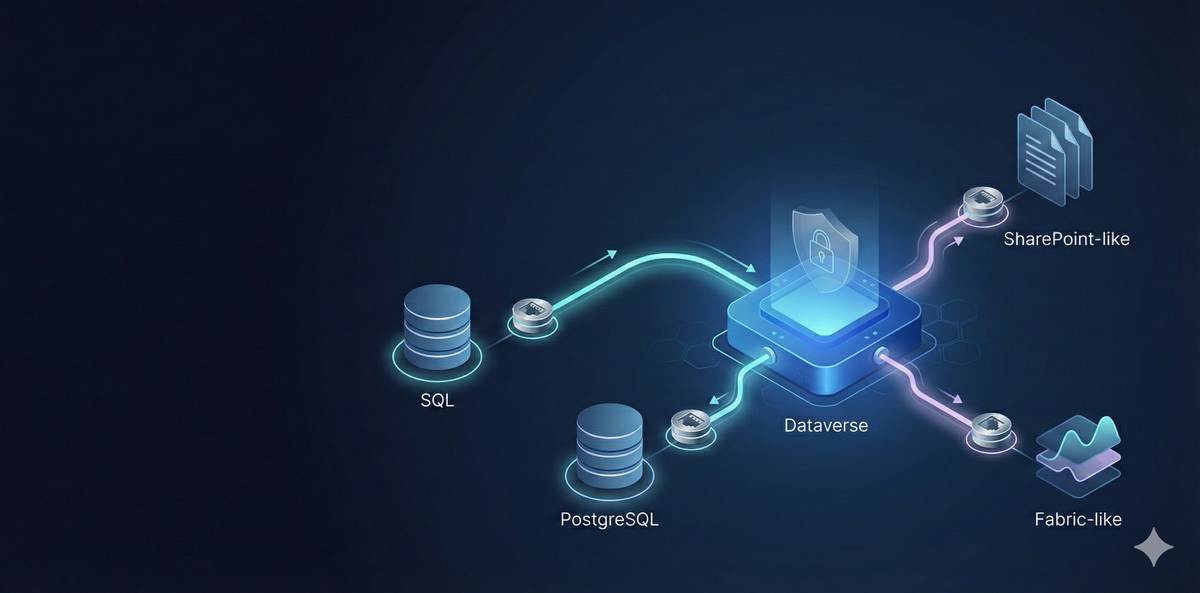
In practice, teams commonly use SharePoint, SQL Server, PostgreSQL, and Fabric-related data patterns depending on data ownership and performance requirements.
Virtual vs Standard vs Elastic tables
Standard Dataverse tables
- Best for core transactional business data.
- Broadest Dataverse feature support.
- Preferred when Dataverse should own data lifecycle.
Elastic Dataverse tables
- Best for high-volume, high-ingestion scenarios.
- Scale-oriented behavior.
- Feature trade-offs versus standard tables depending on workload.
Virtual tables
- Best when source data must stay external.
- Useful for integration-heavy and phased-modernization projects.
- Runtime behavior depends on source latency and availability.
Technical advantages
- No mandatory data replication.
- Faster initial integration for read-centric scenarios.
- Lower Dataverse storage pressure for large external datasets.
- Cleaner source-of-truth model when external systems are authoritative.
Technical disadvantages
- Not all Dataverse features are available in the same way as native tables.
- Performance is constrained by external source query quality.
- Availability and network path become critical dependencies.
- Security/ownership boundaries need explicit governance.
Ports and connectivity checklist
- SQL Server: TCP 1433 (typical default; can vary by instance).
- PostgreSQL: TCP 5432 (typical default).
- SharePoint Online / connector APIs: HTTPS 443.
- Fabric and Microsoft cloud data endpoints: HTTPS 443.
Always validate firewall rules, private endpoint strategy, gateway requirements, and DNS resolution path in your target environment.
Architecture recommendations
- Contract first: expose stable external views/entities and predictable keys.
- Optimize source queries: index fields used for filtering/sorting/joins.
- Keep scope intentional: start with read-focused virtual tables before adding write complexity.
- Design fallback UX: show meaningful states when external source is unavailable.
- Monitor dependencies: source latency, connector limits, transient errors, and throttling patterns.
When Virtual Tables are the right call
- Compliance or ownership rules block full data copy into Dataverse.
- Legacy platform remains authoritative but apps need modernization now.
- Near real-time visibility is required and ETL lag is not acceptable.
- You want phased migration with minimal disruption.
Practical production checklist
- Benchmark key app queries with realistic data volume.
- Load-test list/filter operations from the actual app UX.
- Document ownership between Power Platform and data-platform teams.
- Define incident runbook for source-side degradation.
- Reassess periodically whether data should remain virtual or move to standard tables.
Conclusion
Virtual Tables are not a generic replacement for Dataverse storage. They are an integration strategy. Used in the right place, they reduce duplication, accelerate delivery, and keep architecture aligned with real source ownership.
If you want help reviewing your table strategy and connection design, you can reach me at www.lago.dev.