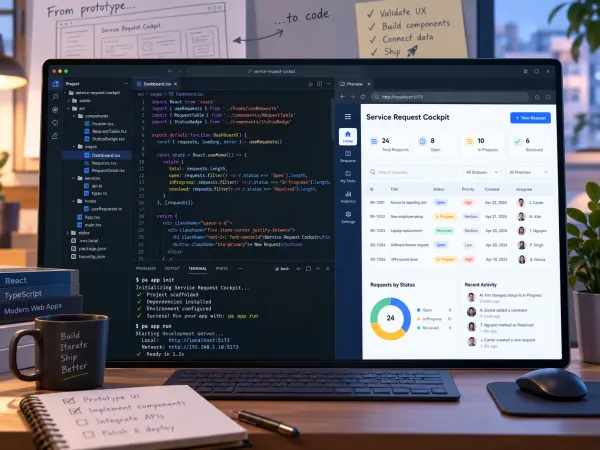
From Vibe to Production: Turning AI Mockups into Real Power Apps
Learn how to turn a Power Apps Vibe prototype into a Code App, connect Dataverse and Azure Logic Apps, and deploy and maintain it with proper ALM.


Learn how to turn a Power Apps Vibe prototype into a Code App, connect Dataverse and Azure Logic Apps, and deploy and maintain it with proper ALM.

Comparing Logic Apps, Azure Functions, and Dataflows for bulk and scheduled Power Platform integrations For years, the default answer to almost every integration question was reassuringly simple: build a flow. Need to move data between systems? A flow. Need to sync nightly? A flow with a recurrence trigger. Need to

Queues, topics, subscriptions, and the three ways to consume them For years, the default answer to almost every near real-time integration question in the Power Platform was reassuringly simple: build a flow. When the record changes, the flow fires, the connector runs, the external system updates. It works. Until

Choosing the right integration interface for Power Platform database tables The default answer to almost every Dataverse integration question used to be reassuringly simple. Pick a connector, wire it to a flow, and call it a day. The connector catalogue has grown. The integration surface has expanded. And the question

Enterprise integration architecture for Power Platform and Dataverse: a three-part series For years, the default answer to almost every Power Platform integration question was reassuringly simple: build a flow. When the record changes, the flow fires, the connector runs, the external system updates. It works. Until it does not.

A practical deep dive into Power Platform custom connectors: what they are, how to create them fast with Postman, licensing requirements, and production governance.

Microsoft kills the Power Automate mobile app. Your approvals still work. Your notifications do not. Effective August 31, 2026, the Power Automate mobile app for iOS and Android is deprecated. Microsoft removes it from the App Store and Google Play, stops updates, and ends support. Power Automate itself is not

A SKILL.md file is a Markdown file with YAML front matter and some instructions. You write it in any text editor, upload it to your agent, and the orchestration runtime decides when to activate it. The barrier to entry is low. The barrier to safety is not. The problem
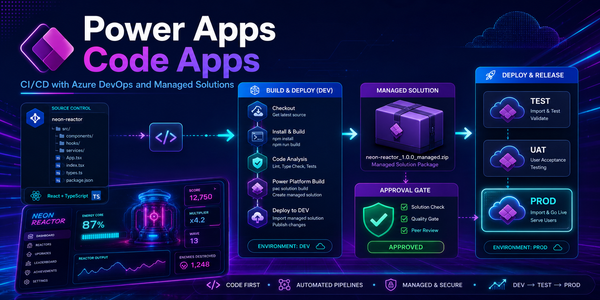
Power Apps code apps give us something Power Platform developers have wanted for a long time: a proper code-first development experience without leaving the managed Power Platform runtime. We can build with React, TypeScript, Vite, or another familiar web stack, work locally in our preferred IDE, store everything in
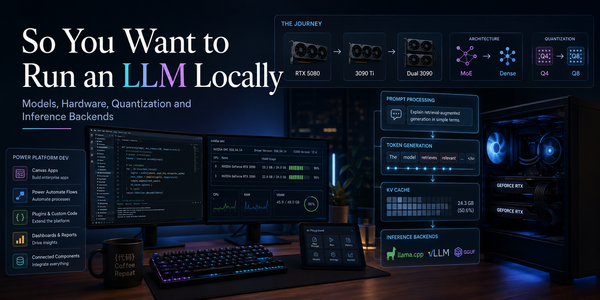
In the previous article, we looked at the architectural decision between Microsoft Foundry and locally hosted language models. This time, we are crossing to the other side of the fence. You have decided to run an LLM locally, or at least to evaluate the option seriously. Now you are staring
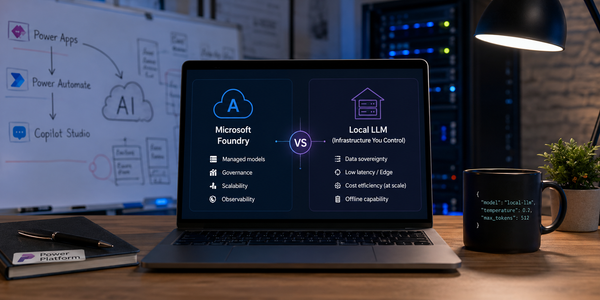
Generative AI is no longer a futuristic experiment. Enterprises are moving models into customer service, document processing, knowledge management, software development, and operational workflows. As those projects move from proof of concept to production, one architectural question appears remarkably quickly: Should we consume a managed cloud model, or deploy an
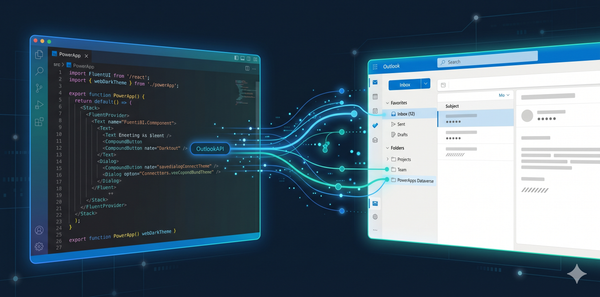
In Part 1 we scaffolded a code app, installed Fluent UI, and built a Google-style search UI. It was a proof of concept — a shell with no real data. This is where Part 1 stops, and this post picks up: how do you connect a code app to real