Power Platform Release Wave 1 (2026): What Actually Matters
Power Platform Wave 1 2026 explained with feature-by-feature breakdown, hype score, and subjective take for each major update.

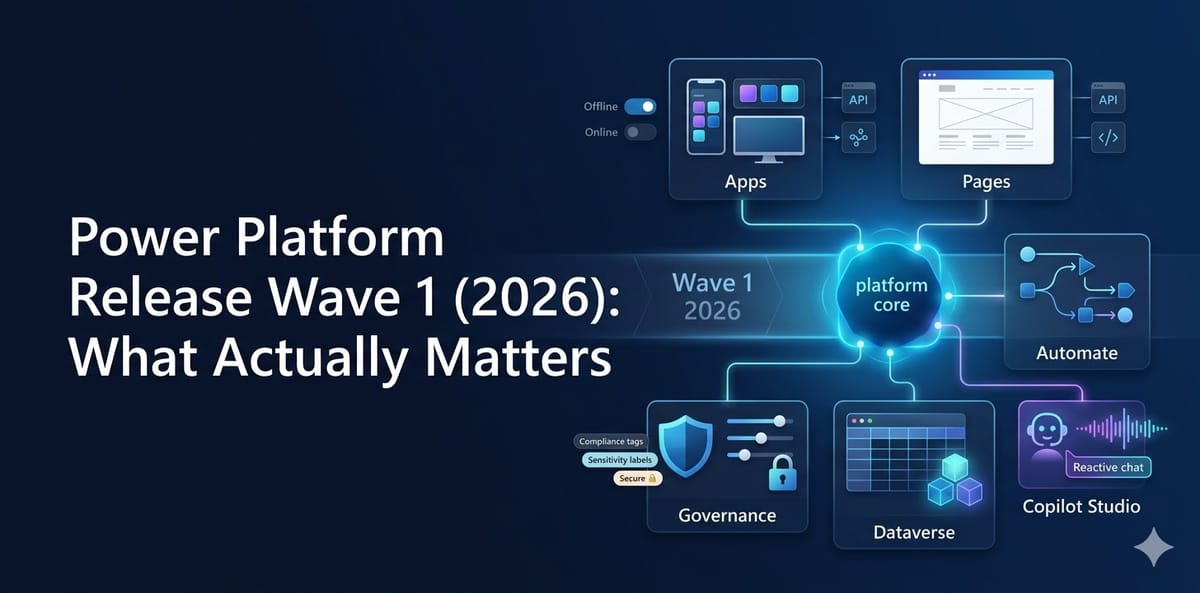
Power Platform Release Wave 1 (2026) is one of those waves where the value is not in one flashy announcement. The real value is in platform maturity: better offline behavior, cleaner security boundaries, stronger governance, and practical MCP-based extensibility.
This post covers Power Platform only (not Dynamics 365). For each feature, I’ll give you three things: what it is, why it matters, and my subjective take + hype score.
Power Apps
FetchXML in Offline Profiles
Preview: March 2026 · GA: April 2026 [R1, pp. 11–12]
What it does: Brings direct FetchXML editing into offline profile configuration for canvas and model-driven scenarios. Makers can fine-tune query logic under related rows and custom filters, without context-switching to external tools.
Why it matters: Offline datasets are where performance and usability live or die. Better query control means leaner offline payloads, faster sync, and fewer “why is this not available offline?” incidents.
Hype level: ⭐⭐⭐⭐☆ (4/5)
My take: Not sexy, very important. This is one of those admin/maker features that quietly improves production reliability.
Online Mode in Offline-First Canvas Apps
Preview: April 2026 · GA: May 2026 [R1, pp. 15–16]
What it does: Adds an online mode toggle for offline-first apps so users can hit live Dataverse when connectivity is available. App remembers last mode and guides users back to offline when network drops.
Why it matters: This solves the classic offline tension: resilience vs freshness. You get both, with explicit user control.
Hype level: ⭐⭐⭐⭐⭐ (5/5)
My take: One of the most practical updates in the wave. Real business users will feel this immediately.
Power Pages
Unified Authorization Model (Web Roles + Dataverse Security Roles)
Preview: March 2026 · GA: August 2026 [R1, pp. 56–57]
What it does: Aligns Power Pages authorization model with Dataverse security role representation and system user context (including C2 user handling), while syncing existing records automatically.
Why it matters: Authorization sprawl is expensive. Centralizing logic in Dataverse simplifies audits, governance, and long-term maintenance.
Hype level: ⭐⭐⭐⭐☆ (4/5)
My take: Great architecture move. The less duplicated auth logic you have, the less pain you’ll have later.
Enable Secure Server-Side Logic in Power Pages
Preview: Oct 13, 2025 · GA: April 2026 [R1, pp. 65–66]
What it does: Enables secure server-side JavaScript execution for Pages workloads, supporting external integrations, advanced operations, and publishable API consumption patterns.
Why it matters: Sensitive business logic should not live in browser scripts. This reduces credential leakage risk and brittle client-side hacks.
Hype level: ⭐⭐⭐⭐⭐ (5/5)
My take: Big win for serious projects. This turns Pages from “just low-code website” into a more credible app platform surface.
Power Automate
Reference Previous Prompts in Copilot for Desktop
Preview: June 30, 2025 · GA: May 2026 [R1, pp. 93–94]
What it does: Gives Copilot for Power Automate Desktop contextual memory across prompt chains (file paths, params, objects, prior intent).
Why it matters: Better context continuity lowers prompt friction and reduces authoring mistakes in complex desktop automations.
Hype level: ⭐⭐⭐⭐☆ (4/5)
My take: This is quality-of-life that compounds. Not a headline feature, but a daily productivity multiplier.
Object-Centric Process Mining
Preview: Nov 14, 2025 · GA: April 2026 [R1, pp. 102–103]
What it does: Supports multi-object event modeling, richer mappings, and analysis of process behavior across interconnected entities, with ingestion from Azure Data Lake/OneLake.
Why it matters: Real processes are not one-object diagrams. This gives more truthful process intelligence and better root-cause discovery.
Hype level: ⭐⭐⭐⭐☆ (4/5)
My take: Huge for process-heavy enterprises. Probably underhyped compared to AI features, but strategically more durable.
Microsoft Copilot Studio
Connect Any Agent to External Data with Custom MCP Servers
Preview: March 2026 · GA: April 2026 [R1, pp. 126–127]
What it does: Lets teams build MCP servers from connectors, APIs, and existing tools; clone Microsoft-hosted variants; and apply governance via DLP and access controls.
Why it matters: MCP is becoming the integration contract for agents. Reusable server patterns reduce duplicated integration effort.
Hype level: ⭐⭐⭐⭐⭐ (5/5)
My take: Core strategic feature. If you’re building enterprise agents, this is foundational.
Build Enhanced Connectors with Connector SDK + Power Fx
Preview: May 19, 2025 · GA: May 2026 [R1, pp. 149–150]
What it does: Expands structured-data connector capabilities and improves integration with maker experiences and Copilot Studio knowledge grounding.
Why it matters: Better connectors = better apps and better agents. This is infrastructure for everything else.
Hype level: ⭐⭐⭐⭐☆ (4/5)
My take: Technical, but high leverage. Connector quality often decides whether a platform scales cleanly.
Build Connectors with OpenAPI v3
Preview: February 2026 · GA: May 2026 [R1, pp. 151–152]
What it does: Enables custom connector creation from OpenAPI v3 without downgrading to v2.
Why it matters: Removes pointless translation friction and modernizes connector authoring for API teams.
Hype level: ⭐⭐⭐⭐☆ (4/5)
My take: About time. This should have happened earlier, but it’s a welcome cleanup move.
Automate Web and Desktop Apps with Computer Use
Preview: May 27, 2025 · GA: May 2026 [R1, pp. 122–123]
What it does: Enables agent-style GUI automation for websites/desktop apps where no API exists, using computer vision + reasoning (CUA pattern).
Why it matters: API-less systems are everywhere. This gives teams a path to automation where traditional integration is blocked.
Hype level: ⭐⭐⭐⭐⭐ (5/5)
My take: Powerful and risky. Massive upside, but governance and guardrails are non-negotiable.
Dataverse
Discover, Build, Customize, and Extend with Management MCP Server
Preview: March 2026 · GA: April 2026 [R1, pp. 169–170]
What it does: Provides environment-scoped MCP discovery/build endpoint with broad connector/action search and cloning/customization flows.
Why it matters: Makes MCP lifecycle operational, not ad hoc. Better discoverability means less duplicated agent integration work.
Hype level: ⭐⭐⭐⭐⭐ (5/5)
My take: Quietly one of the most strategic Dataverse additions this wave.
Governance & Administration
If you are running Power Platform at scale, this section is your biggest ROI.
Move Apps Out of the Default Environment
Preview: Jan 30, 2026 · GA: April 2026 [R1, pp. 188–189]
Hype: ⭐⭐⭐⭐⭐ (5/5)
Opinion: Excellent. Default environment debt has hurt governance for years.
New Usage Page for Adoption
Preview: Feb 13, 2026 · GA: June 2026 [R1, pp. 191–192]
Hype: ⭐⭐⭐⭐☆ (4/5)
Opinion: Finally gives admins better product-level usage visibility without external reporting gymnastics.
Enhanced Agent Security Controls
Preview: March 2026 · GA: April 2026 [R1, pp. 197–198]
Hype: ⭐⭐⭐⭐⭐ (5/5)
Opinion: Critical. Agent adoption without this level of control is not enterprise-ready.
Permit or Deny Guest Access per Environment
Preview: Nov 18, 2024 · GA: May 2026 [R1, pp. 199–200]
Hype: ⭐⭐⭐⭐☆ (4/5)
Opinion: Simple control, big governance impact.
Sensitivity Labels in Connectors & Copilot Studio
Preview: Nov 30, 2025 · GA: June 2026 [R1, pp. 203–206]
Hype: ⭐⭐⭐⭐☆ (4/5)
Opinion: Essential foundation for serious information protection in agent and integration scenarios.
My practical priority order
- Governance hardening (default env, guest access, agent controls)
- MCP strategy (what to build, clone, secure, and standardize)
- Connector modernization (OpenAPI v3 + SDK practices)
- Offline and automation productivity improvements
References
- R1: Microsoft Power Platform 2026 release wave 1 PDF plan (Microsoft Learn, 18 March 2026): https://go.microsoft.com/fwlink/?linkid=2353439
- R2: Microsoft Power Platform 2026 wave 1 overview: https://learn.microsoft.com/en-us/power-platform/release-plan/2026wave1/
- R3: User draft source document.
Release dates and feature scope can change according to Microsoft release-plan policy.